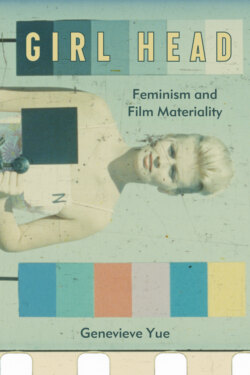
Girl Head shows how gender has had a surprising and persistent role in film production processes, well before the image ever appears onscreen. For decades, feminist film criticism has focused on issues of representation: images of women in film. But what are the feminist implications of the material object underlying that image, the filmstrip itself? What does feminist analysis have to offer in understanding the film image before it enters the realm of representation? Girl Head explores how gender and sexual difference have been deeply embedded within film materiality. In rich archival and technical detail, Yue examines three sites of technical film production: the film laboratory, editing practices, and the film archive. Within each site, she locates a common motif, the vanishing female body, which is transformed into material to be used in the making of a film. The book develops a theory of gender and film materiality through readings of narrative film, early cinema, experimental film, and moving image art.This original work of feminist media history shows how gender has had a persistent role in film production processes, well before the image ever appears onscreen.
Оглавление
Genevieve Yue. Girl Head
Contents
Plates and Figures. Plates
Figures
Introduction
Materiality
Methodology
The Disappearing Female Body
Looking Back
1. China Girls in the Film Laboratory
Control
Test Cards
Color
Obsolescence
The Face of the China Girl
The China Girl in Experimental Film and Video
2. Gone Girls of Escamontage
Tricks of Continuity
Unravelling Rope
Invisible Editing
Cutting Women
3. Gradivan Footsteps in the Film Archive
Tracing Gradiva
Women in the Film Archive
Afterword
Acknowledgments
Notes. Introduction: The Body of Medusa
1. China Girls in the Film Laboratory
2. Gone Girls of Escamontage
3. Gradivan Footsteps in the Film Archive
Afterword
Bibliography
Index
Отрывок из книги
GIRL HEAD
2 China Girl, circa early 1930s
.....
I analyze this motif to clarify how this vanishing, whether violent excision or mere overlooking, was made possible. In other words, I take the absent woman as a problematic to be dissected and better understood. This is different from other scholarly approaches that are also concerned with disappeared women which either try to fill gaps in the historical record, as with feminist scholarship concerned with restoring women to a history they have been written out of, or to further bury the traces of the woman’s body in the formulation of an aesthetic theory (in art history and film theory). Both approaches, paradoxically, produce additional occlusions, which I take up in my own theoretical inquiry.
The first approach is represented by feminist film historians working in a positivist mode to restore or recuperate women deemed missing from film history. This work follows a longstanding and largely correct view that many female figures have been excluded from the historical record. To redress this exclusion, feminist scholars since the 1970s have embarked on empirical research into women’s contributions to film history and production. Lucy Fischer’s “The Lady Vanishes: Women, Magic and the Movies” (1979) is exemplary in this regard. The essay both interrogates the patriarchal logic by which early trick films involved male magicians performing often gruesome acts on female bodies (“the rhetoric of magic … constitutes a complex drama of male-female relations”23) and revises the history of magic films along feminist lines, reading an envy of female reproductive capabilities into the actions of male magicians and expanding the historical record to include films featuring female magicians.