Оглавление
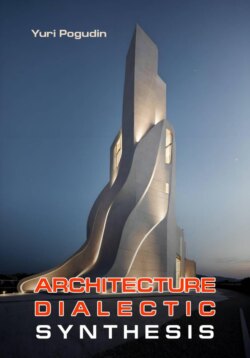
Группа авторов. Architecture. Dialectic. Synthesis
Preface to the English edition
Preface to the 2025 edition
DIALECTIC OF ARCHITECTURE. Preface
Introduction
Essence of Architecture
Architecture as a Second Body
Architecture as a Materialized Worldview
The General Architectural Ennead
Function – Aesthetics
Structure
Layout – Tectonics
Interior – Exterior
Scale Category
The Dialectic of Function
The Antithesis of Historical Space and Architectural Form
Essays on the History of Architecture by Antithesis
Cubicity – Sphericity / Straightness – Curvilinearity
Massiveness – Transparency / Closeness – Openness
Meter – Rhythm / Regularity – Randomness
Symmetry – Asymmetry
Right – Wrong / Rational – Irrational
Verticality – Horizontality
Interior – Exterior / Window – Wall
The Limits of Architecture. Form and Light
Conclusion
References
SYNTHESIS OF ARCHITECTURAL FORM. FROM MEANING TO CONCEPT. Preface
Introduction
Types of Architectural Composition
On the concept of N. A. Ladovsky
Principles of dialectical philosophy of A. F. Losev
The Three Forces That Create an Art Object
The Basis of the Method Is a Dialectical Triad, a Synthesis
Justification of translation between heterogeneous languages in the concept of Yu.M. Lotman
Types of Synthesis in Architectural From Creation. Elements and Trajectories
Examples from the History of Architecture
Opposition Categories of Architectural Form
Principles of Harmonious and Expressive Architectural Composition
Dictionary of Form-Generating Transformations
Dictionary of Architectural Form-Generating Actions
Verbal–Associative Method. Dictionary of Messaging Themes
Conclusion
Morphogenesis Experiments. Sketches by the author
Examples of work by Archineo Studio students
Morphogenesis Experiments. Working in a neural networks
References
MANIFESTO OF DIALECTICAL SYNTHETISM AND ARCHITECTURE
DIALECTICAL AND GENETIC TYPOLOGY OF ARCHITECTURAL FORMS (experimental futurology of architectural form generation)114
VISUAL ENERGETICS IN ARCHITECTURAL MORPHOGENESIS (architectural form as an expression of force, tension and movement)115
TYPES OF SPATIALITY IN THEIR CORRELATION WITH AESTHETICS AND STRUCTURAL CHARACTER OF ARCHITECTURE120
Отрывок из книги
Dear readers, the translation of this book was performed by a friend of our family, Anna Kanunnikova. I am deeply grateful to her for the work.
The author hopes that the proposed direction will contribute to new architectural searches and discoveries.
.....
A building, as internal to itself and as external to itself, is, respectively, an interior and an exterior. The interior is the building in its internal expression, the interior of the building. The existence of the interior distinguishes an architectural form from sculptural and other forms. A sculptural form is a purely exterior form, it is external to itself. The interior contains the specifics of architecture as a container. The interior is the building's inward orientation, into itself as an integrity distinct from the environment. The exterior is, on the contrary, the building's exit outside, into the external world, its manifestation to the space of the surrounding world.
This only captures the antithesis of the interior and exterior as the opposition of the building to itself. Dialectics then examines categories from the point of view of their otherness, and establishes the transition of opposites into each other. Otherness to the building is a human subject. The interior is a form encompassing this subject. Consequently, the subject turns out to be an internal content in relation to the interior, and the interior in its relation to the subject is an external thing. The exterior category also undergoes a similar transition to its opposite when correlated with the otherness. The exterior in relation to the subject presupposes the possibility that the perception of the subject embraces it, if not simultaneously, then sequentially, with the in a circular, ambient motion. This means that the exterior is the inner content in the encompassing perception of the subject.
.....