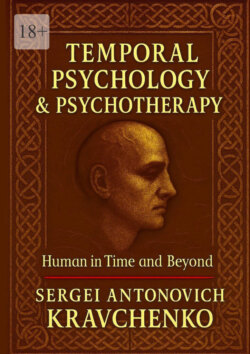
Читать книгу Temporal Psychology and Psychotherapy. The Human Being in Time and Beyond - - Страница 4
PREFACE
Why the Temporal Matters
Оглавление(From the Diaries, 2025)
Time and soul are close in nature: decipher one, and much becomes clear in the other.
Psychology has traditionally studied the space of the psyche – its structures, levels and mechanisms.
Far more rarely has it addressed its time – the temporal dimensions in which the consciousness of an individual, a group, and perhaps the deepest nature underlying all living things unfolds.
Time has long been a subject of sustained philosophical and scientific reflection:
from the ancient meditations of Plato and Aristotle on eternity and cycles —
through Husserl’s phenomenology and Heidegger’s existential philosophy —
to modern interpretations in cognitive science and psychotherapy.
In psychology many masters touched the theme of time,
but each saw only a fragment of this multidimensional phenomenon.
Freud worked with the past – childhood traumas, repressed experience, memory that continues to live in the present.
This is essential, but only one dimension of temporality.
Jung showed that the psyche is not limited to linearity:
he wrote about forefeelings, «dreams of the future,» and synchronicity – coincidences that transcend causality and hint at supra-temporal meanings.
Adler saw the human being as oriented toward the future: striving and goal organize behaviour.
Husserl explored the structure of time-consciousness through retention and protention:
consciousness is always stretched between past and future and never exists in a «pure present.»
Heidegger reminded us that the human being is being-toward-death, a creature living in the horizon of the future.
Rogers emphasized the significance of the here-and-now, seeing the person as a continuous process unfolding in time.
One way or another, the great thinkers touched time,
but only a few made it the central category of psychology.
The temporal perspective proposed here reverses the order:
time becomes the core of the psychic,
and the psyche is understood through its temporal dimensions.
A person lives not only in the present —
he or she constantly dwells in the past and the future,
and sometimes – for the few – in states that lie beyond linear time,
where nothing «should» be, yet something is.
These dimensions are not abstractions but real forms of experience.
We live by memories and forefeelings, hopes and fears;
we reach for eternity, even without realizing it;
we suffer from the time-void, yet seldom recognise it as the cause of alienation and depression.
The awareness and differentiation of temporal layers open new horizons in clinical practice:
a therapy that embraces past, present and future
can not only relieve symptoms
but restructure the temporal architecture of personality,
reducing the time-void and bringing a person closer to inner wholeness.
The practical significance of this shift in paradigm is immense.
Temporal psychotherapy makes it possible to:
– recognise hidden sources of suffering when they are rooted in «unexpected» layers of time;
– work with anticipations and future projects as therapeutic resources;
– restore connection with archetypal foundations that provide stability in the flow of time;
– integrate the experience of eternity and meaning-making into the process of healing.
This is not merely a new concept – it is an invitation to see the psyche as a fabric woven of time.
Understanding temporality grants not only theoretical clarity
but clinical power: the ability to discern the path appointed by nature
and, together with the patient, step out of destructive time-void
toward the fullness of psychological health.
Time is not only the stream in which we float;
it is the fabric from which the soul is woven.
(a paraphrase of C. G. Jung)