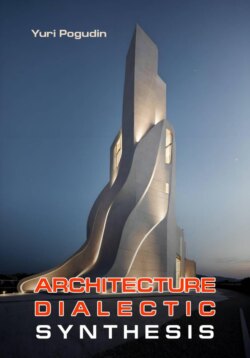
Читать книгу Architecture. Dialectic. Synthesis - - Страница 6
Essence of Architecture
Architecture as a Second Body
ОглавлениеFor a better understanding of the essence of the architectural form, let's compare it with the sculptural form. For this purpose, let us turn to the reasoning of Aleksei Losev in his "Dialectic of Artistic Form":
"…What is the difference between a sculptural form and an architectural one? To say that the difference lies in the material is ridiculous and strange. To say that one depicts people, and the other protects people from precipitation, is also ridiculous, because sculptures can have features protecting from precipitation, and architecture can depict a living being, something like the famous Trojan horse2. What is the difference, then? I see it only in the fact that architecture organizes pure materiality, that is, mass, volume and density, pure facticity and positedness, fixedness. There is nothing like that in the sculpture. Architecture gives weight to pure materiality, massive three-dimensional dense space, and presents space as a force field. That's why the architectural form is attributed to the first dialectical category in the general sphere of tectonism, to the category that speaks only of pure positing, pure potency, of the one, which as such is above all formalization, because it establishes and generates this formalization. Being reflected on the fourth principle, this principle gives, as we saw in paragraph 2, the categories of mass, volume and density. Architecture is the art of pure mass, pure volume and pure density, as well as their various designs and combinations. And the most important thing is that we thought of the fourth principle, as we remember, only as a carrier, a container of meaning, not meaningful in itself, but only positing, really fixing the intelligent element of pure meaning. Therefore, the architectural form is always the form of a carrier, a container of something else, more internal. An architectural work is architectural one not because it is a dwelling, a temple, and nature, but because its dialectical place is in the realm of pure hypostatization and positedness of meaning, from which it is clear why it is always a container. Sculpture, on the other hand, does not deal with space as such, that is, spreading as such. What is important to it is not the weight distribution itself in its qualitative nature, but what exactly is spread out, the single units that are spread out in a weighty way in space. If an architectural work is always a container, then in sculpture we already see what exactly is contained in the body, although not without the body, because otherwise it would be painting, poetry or music. Hence, in my classification, this form belongs to the category of incarnation of the second principle in the fourth one. The second principle, eidos, is precisely the semantic "what" of every incarnation in the sphere of tectonism. – Such is the dialectical structure of sculptural and architectural forms.3"
Architecture is a container, and the ability to contain is the main property of space. Space is primarily characterized by the ability to accommodate things, both at rest and moving. Therefore, architecture can be defined as a form of space, a material form of space. The sculptural form is the form of the material. Sculpture needs space as a sphere of its existence, while architecture is engaged in shaping this space. It explains the famous aphorism of Nikolai Ladovsky: "Space, not stone, is the material of architecture.4" Space is the subject of architectural activity, well-formed space is the goal of architecture, and materials and structures are the means to achieve this goal. Architecture obviously follows the path of liberation from materials and structures by striving to create structures that realize any form. Architect Leonid Pavlov spoke about this, crystallizing his thoughts in the paradox of the fundamental immateriality of architecture. Architecture, in the limit, strives to entirely free itself from the dictates of material and structures, and to become the architecture of certain force fields, etc. Of course, this means liberation from coarse material (metal, glass, concrete, etc.), and not from matter as such. The force field is also more subtle matter. And architecture always remains the material arrangement of a space containing people and nature. The means of architecture are evolving, but its meaning and purpose remain unchanged. In such a way, the form of the living space is created.
In the system of dialectics of the artistic form developed by Losev, architecture is 5quite logically attributed to the first semantic principle, since architecture is the most general unifying basis for all other arts. The basis is the first principle of Meaning in Losev's triad of Basis, Form, and Action6.
On the other hand, the dialectic of human activity derived from anthropology justifies the location of architecture precisely in the fourth semantic principle, since it is thought of precisely as embodying the Triune Meaning, as the body of Meaning7, and Losev quite rightly insists on physicality as the fundamental quality of architecture8. In addition, clarifying the brilliantly clear and simple Losev's definition of architecture as a container, it should be pointed out that architecture is precisely the container of the body, and, even more specifically, of the human body. Architecture reveals its meaning not just as a container, but as a container of the human body in its life and functioning. After all, a tree hollow accommodates a woodpecker, but it is not an architectural phenomenon. Further, as we understand essence of architecture in this way, it is necessary to establish a semantic connection between the building, the house as a unit of architecture and the human body. This connection is remarkably illustrated by Fr. Pavel Florensky. Developing the idea of so-called organoprojection, which is that "tools expand the scope of our activity and our senses by continuing our body," the 9philosopher writes: "Let us now turn to the synthetic tool that combines many tools and, fundamentally speaking, all tools. This tool is a dwelling, a house. All the tools are collected n the house, as the center, or are located at the house, near it, related to it, they serve it. What is the projection of a dwelling? What exactly is projected by it? By its design, the dwelling should combine the totality of our tools – our entire household. And if each tool separately is a reflection of some organ of our body from one side or the other, then the whole set of economy, as one organized whole, is a reflection of the whole set of functional organs, in their coordination. Consequently, the dwelling has the whole body in its entirety as its prototype. Here we recall the common comparison of the body with the house of the soul, with the dwelling of the mind. The body is likened to a dwelling, for the dwelling itself is a reflection of the body. <…> A house is like a body, and different parts of household equipment analogically correspond to body organs. The water supply system corresponds to the circulatory system, the electric wires of bells, telephones, etc. correspond to the nervous system, the furnace corresponds to the lungs, the chimney corresponds to the throat, etc., etc.10 And it is clear that it cannot be otherwise. After all, when we dwell in a house with the whole body, we accommodate ourselves in there with all our organs. Consequently, the satisfaction of each of the organs, that is, giving it the opportunity to act, occurs only through the house, and therefore the house must be a system of tools that extend all the organs.11"
It follows from the reasoning of Fr. Pavel Florensky that architecture is an organization and arrangement of the human economy in material structural shells. The economy is the unfolding of the body's functions in their entirety.
It is logical to extrapolate the meaning of the house as an extension of the entire human body to the entire architecture and think of it as the dwelling of humanity and the home of humanity's physicality. Architecture is, therefore, the continuation and unfolding of physicality in nature. This is the main essence of architecture in relation to the body category. Thus, in the dialectic of human activity, architecture correlates with the fourth principle of meaning, which is presented clearer in the table of concepts below.
Let us briefly summarize Losev's dialectic of man and his activities.
The category of architecture follows from the category of the human body, in relation to which nature is considered as otherness. Architecture arises as a result of placing the human physicality to other-worldly nature.
Hence, in order to clarify the dialectical basis of architecture, it is necessary to consider the place of the category of the body in the dialectic of man. According to A. Losev12, the dialectic of man is revealed in the following pentad:
1) Heart; 2) Mind; 3) Aspiration; 4) Body; 5) Person.
The body here acts as a substance that implements the triune elements of the heart, mind and aspiration. In the sphere of human activity, it will correspond to the triad of religion, science and art. Religion is the only element that captures the last depth of a person's being – the heart, and which calls for bringing this heart as a gift to the Absolute. Science results from the activity of the mind. Aspiration expresses itself in thirst and search for beauty, taking shape in art. In man, the heart, mind, and aspiration embody the body, and in human activity, religion, science, and art are embodied by architecture. This is also where Vitruvius' famous triad comes from – durability, usefulness, beauty, embodied in an architectural form. Thus, the following dialectical series arise:
The proposed system provides a solid basis for the widespread definition of architecture as a synthesis of science and art. Many books on architecture highlight the combination of scientific, technical and artistic principles in architecture as its distinctive feature. This means that architecture is neither a science nor an art, but a dialectical synthesis of both.
We will return to the triad of Vitruvius later, since now it is still necessary to highlight a number of significant points and historical explanations to the established basic understanding of architecture as human corporeality in nature.
So, architecture is not a second nature, but a second body, the second corporeality of humanity, it is the otherness of the human body in nature, its continuation and development, the unfolding of the body in nature. It results in the anthropomorphism of architecture as its main characteristic for many centuries.
Vitruvius refers to the human body as an example of artistic proportionality, arguing that "a beautiful building should be built "like a well-built man." Similarly, Michelangelo asserts that "the parts of an architectural whole are in the same ratio as the parts of the human body, and those who did not know and do not know the structure of the human body in the anatomical sense cannot understand this." He compares the exterior of the building with the face, which is primarily the exterior of the body. "If there are different parts in the plan," Michelangelo wrote, "then all similar parts in quality and quantity should be decorated and ornamented in the same way. If one part changes, then it is not only allowed, but also necessary to change its ornamentation, as well as of the respective parts. The main part is always free, like the nose, located in the middle of the face, it is not connected to either one or the other eye; the hand should be like the other one, and one eye should be like the other.13"
Architecture was developed based on the assimilation to the human body in Ancient Greece, as well as in Ancient Russia – and to an even greater extent, since not only individual parts of the temple (columns) are compared to the body here, but the temple as a whole. But even then, when architecture (the building as a whole, its parts) does not evoke associations with the forms of the human body, it is still, in its deep meaning, the mode of existence of human physicality in nature. It's about the meaning, not the external resemblance. Modern architecture, which has moved away from anthropomorphism, nevertheless cannot but unfold the body in nature. Externally, the architecture of a particular era may not only not express the similarity with parts of the human body, but also, on the contrary, show something superhuman and exceeding the immediate physicality. So, Egyptian architecture is distinguished by a certain grandiose power, with which a "little" man is incommensurable. But it was in Egypt that architecture had, like nowhere else, such a huge mythological significance – to realize and materialize human immortality through the preservation of the body. According to well-known Egyptian beliefs, only those whose bodies remained intact were awarded with the afterlife. The thick walls of the tombs and pyramids were a guarantee of eternal life: the trap system was an actual protection from robbers, from damage to the Pharaoh's body and memorial furnishings, and the durable stone both symbolized and materialized the idea of eternity.
2
The twenty-meter-high and sixty-meter-long Great Sphinx of Chephren shows the relativity of the difference between architectural and sculptural forms in terms of size (note mine – Yu.P.).
3
Losev A.F. (1995) Forma. Stil. Vyrazhenie. [Form. Style. Expression]. Moscow: Mysl. – pp. 122-123. (in Russian)
4
Mastera sovetskoy arkhitektury ob arkhitekture [Masters of Soviet Architecture about Architecture], vol. 1. (1975) Moscow: Iskusstvo. (in Russian) – p. 344.
5
Losev A.F. (1995) Forma. Stil. Vyrazhenie. [Form. Style. Expression]. Moscow: Mysl. – p. 124. (in Russian)
6
Losev A.F. (1999) Lichnost i absolyut [Personality and the Absolute], Moscow: Mysl, – p. 381. (in Russian)
7
Losev A.F. (1999) Lichnost i absolyut [Personality and the Absolute], Moscow: Mysl. – p. 243, 411-412. (in Russian)
8
Losev A.F. (1995) Forma. Stil. Vyrazhenie. [Form. Style. Expression]. Moscow: Mysl. – pp. 122. (in Russian)
9
Florensky P. A.(1999) Works in four volumes, vol. 3(1). Moscow: Mysl. (in Russian)
10
Updating these comparisons in accordance with today's technological developments, we can say that an air conditioner corresponds to the lungs, video surveillance systems correspond to the eyes, a gas or electric stove, a microwave oven correspond to the digestive system, and a computer, of course, – to the brain .
11
Florensky P. A.(1999) Works in four volumes, vol. 3(1). Moscow: Mysl. – p. 415-416. (in Russian)
12
Losev A.F. (1999) Lichnost i absolyut [Personality and the Absolute], Moscow: Mysl, – p. 442-443. (in Russian)
13
Florensky P. A.(1999) Works in four volumes, vol. 3(1). Moscow: Mysl. – p. 416. (in Russian)